
The UK social media ban is asking the wrong question
By Sally Gift, Communications Manager, Womankind Worldwide
Imagine a woman who leaves her abuser, changes her address, only to find her abuser still stalking her by tracking her movements. No social media ban can protect her and that is exactly why the current social media ban in the UK is wrongly fixated on access when it comes to online safety.
Today, 15 June 2026, Prime Minister Keir Starmer has announced the official ban of under 16s from social media, expected to take effect in 2027. This follows months of consultations with many parents in the UK backing this long awaited move.
While this move is long overdue for enforcing accountability on Big Tech when it comes to safety online- the ban debate is asking the wrong question if we’re to holistically ensure tech abuse is recognised as a distinct harm. And this is harm that affects women, girls and children under 16 through surveillance, humiliation and coercive control.
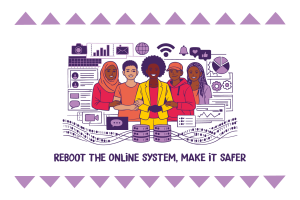
Technology Facilitated Gender-Based Violence (TFGBV) is not a digital problem with a digital solution. It is gendered violence with same patterns of coercive control, harassment, stalking, sexual intimidation running through the infrastructure of everyday life that feminist organisations and movements have documented for years. The technology changes the scale; the speed and evidence trail but the power dynamic does not.
Devices are still weapons, even with platform bans
This was the defining argument of the recently concluded Tech Abuse conference convened by the University College London (UCL) and the Office of the Mayor of London- that TFGBV is no longer niche or emerging concern, but an everyday reality of coercive control embedded in the devices most of us use. The data bears this out where according to Refuge more than 123,000 violent offences against women and girls involving tech abuse were recorded nationally in the UK. The UN has similarly rung the alarm that deepfake videos were an estimated 550 per cent more prevalent in 2023 as compared to previous years and that the tools are morphing rapidly through AI.
Earlier this year in January, X’s Grok AI mass-produced nude content of women and girls including children without their consent, generating millions of sexualised images. Ofcom UK’s own regulator was unable to investigate the app due to the limitations of the Online Safety Act. Simply put, the law had not kept up.
This is not new. As Womankind Worldwide’s Unsafe by Design analysis highlights, TFGBV is part of a continuum of abuse that extends existing patterns of coercive control into digital spaces. Yet, to date, there’s no single national law in the UK that adequately recognises TFGBV as a form of harm legally. With the vast innovation and rapid growth of digital technologies, the law is still playing catch up.
Tech must adapt to safety from the onset
It’s been long argued that women’s safety has always been an afterthought in how tech platforms are designed, regulated and when governments choose to act. Worse still, with intensifying digital violence globally, there’s still no single comprehensive legal framework that adequately recognises TFGBV as distinct form of harm. This is coupled with a rise of tech abuse that continues to deepen impunity not just with zero non-redress reporting mechanisms but weak regulation that doesn’t hold Big Tech platforms to account.
If frontier change that is all encompassing is to be upscaled in ensuring protections for women and girls online safety by design can only be the sustainable solution. This is compulsory safety by design that prioritises preventive steps and not just an after that after harm is done criminally. For example, in the automobile industry, there’s a strong regulation for crash safety before cars leave the factories for the road, why can’t this also connected to safety online from a regulation standpoint?
While we welcome that the social media ban is being considered as some of the preventative measures of child protection, safety online is not just a children’s issue but a gendered power issue. This regulation fails to consider the structural role that platforms continue to play in enabling gender-based violence where everyone is at risk.
A national child abuse crisis should not be all it takes to trigger political action while TFGBV continues to be treated with less urgency. The principle is in calling for stringent structural interventions that enable safety by design across all ages. And this is not just anchored on survivor-led response but platform accountability from the start.
A ban is the easiest political move because it puts the burden on users including families, children and survivors rather than the companies that continue to profit from design choices that enable harm.
The UK government must instead move beyond broad commitments and adopt concrete measures to prevent TFGBV, including embedding safety by design, strengthening platform accountability and addressing the gendered risks posed by emerging technologies. Only then can we ensure that women and girls can participate safely, free from technology-enabled violence, misogyny, and discrimination.