

Countering the backlash – resisting international challenges to women’s rights
By Mike Clulow
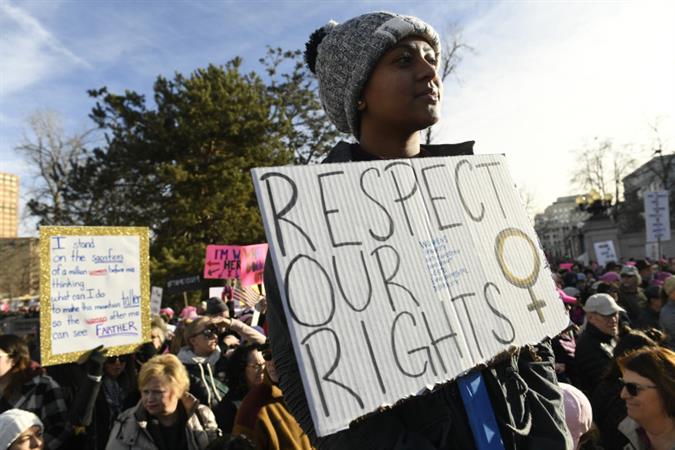
Image source: www.denverpost.com/wp-content/uploads/2018/01/denver-womens-march-2018-_2hr5086.jpg?w=810
Women’s movements have changed the world. Through their campaigns for laws and international agreements that establish and protect women’s rights, and by consistently challenging patriarchy and misogyny, they have radically changed women’s lives.
But this progress is under attack. In our report “Standing with the changemakers” we warn that:
Right now, a global backlash against women’s rights is on the rise … the current global political landscape risks a serious regression on progress made.
The alarm has also been raised by the UN High Commissioner for Human Rights, Zeid Ra’ad Al Hussein:
In too many countries, we are now seeing a backlash against women’s rights … It is extremely troubling to see the recent roll-backs on fundamental legislation in many parts of the world.
Women’s rights activists and allies must act together to oppose the forces that are driving the backlash, and to address the international crises that also undermine women’s ability to claim and defend their rights.
Forces driving the backlash
Religious fundamentalists are gaining influence all around the globe. Christian, Muslim and other fundamentalists see women in similar ways, believing they should leave decision-making to men and dedicate themselves to raising children and caring for their families. Despite religious disagreements, their leaders work together at the national and international level to limit and roll back progress on women’s rights as well as to push back against the recognition of gender and sexual diversity.
Populist extremism is fuelling attacks on women’s rights. Supporters of European populist parties reject progressive values and resent the loss of traditional social norms. Populist policies aim to reverse progress on women’s rights, championing similar gender norms and stereotypes to those promoted by fundamentalists.
Neoliberal economic policies, which place the freedom of the market before human rights, have been implemented by most governments since the 1980s and 90s. It is claimed that this leads to growth that benefits everyone but it actually promotes the consolidation of power and wealth. The gap between rich and poor has grown in almost every region since the 1980s while World Bank data show that GDP per capita in the most economically developed countries increased more than three times as fast from 1960 to 2016 than in the poorest countries. Globalisation has led to some growth in women’s employment but often through jobs with exploitative and dangerous conditions. At the same time, public services have been cut, impacting on women’s health and wellbeing.
The global refugee crisis places the rights of many women at risk. There are now around 20 million refugees, half of them women and girls. They face high risks of rape, transactional sex and human trafficking while changes in gender relations in the family often exacerbate domestic violence. While travelling and in refugee camps, women are confronted by many barriers to reporting abuse and seeking help. In Tanzania, Womankind partner the Women’s Legal Aid Centre, works to support Congolese and Burundian women facing these situations in camps that are currently home to around 300,000 people.
Climate change is reinforcing gender inequalities. Changes in rainfall, rising seas and extreme weather conditions lead to water, fuel, and food shortages, which have a particular impact on women and girls who spend a great part of their time fetching firewood, fuel and water and carrying out other unpaid work. Widespread discrimination that denies women income, legal rights, access to resources or political participation, while making them responsible for caring for their families and providing for their livelihoods, exacerbate the impacts of climate change.
Far from isolated effects
These issues are deeply interconnected. Participants in a recent webinar organised by the Association for Women’s Rights in Development, including Karima Bennoune, UN Special Rapporteur in the field of cultural rights, emphasised the links between the rise of religious fundamentalisms and increasing corporate power and how religious, cultural and nationalist discourses are being used to gain and consolidate social, political and economic power. Women’s rights activists have long identified fundamentalisms as political forces working under the guise of religion and culture.
Women human rights defenders in the firing line
Too often, the backlash against women’s rights turns violent. In 2015, at least 31 women human rights defenders (WHRDs) were murdered as a direct result of their activism. Countries including Afghanistan, Brazil, Nigeria, South Africa and the USA have witnessed an increase in threats and violence against WHRDs. Although many international declarations and commitments exist to protect them, including the Declaration on Human Rights Defenders, which was passed unanimously by the UN General Assembly in 1998, political will to defend WHRDs is lacking and accountability for violations is woefully insufficient.
Resisting the backlash
The backlash against women’s rights is growing but so too is resistance by women’s movements and organisations. Mobilisation against the backlash is happening all over the world.
- In Latin America, the ‘Ni Una Menos’ (Not One Less) movement is fighting femicide and violence.
- In India, women are protesting against mass assault and victim blaming.
- In Poland, thousands of women went on strike and marched against a law to ban abortion.
- In January 2017, millions of women came together on a global scale to march for equality and rights.
Women are also at the forefront of action to address the other issues undermining their rights. In many parts of the world, they are engaged in critical strategies to cope with and adapt to climate change.
Women’s movements have the skills and passion to keep on changing the world but they need support and resources. Womankind stands with them in their resistance and we call on donors, governments, international NGOs and ordinary people to join us.


