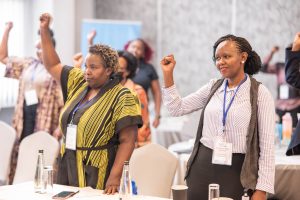

“When we listen to the radio, we know we are not alone”
Nagesa, aged 37, was forcefully evicted from her home in 2014. Since moving to a displacement camp, her husband abandoned her and her children, and she does physical labour to support her family. With support from Womankind partner, National Association for Professional Environmentalists (NAPE), Nagesa has joined a Listeners Club, where she stands in solidarity with other women like her.

“I stopped school at age 12. We were so poor that my family couldn’t afford to keep paying my school fees. I’m an orphan; my father died when I was 11 and my mother when I was 17.
I had no choice but to get married at 18. At first, I was happy. I had land and could grow crops and dig. I had a large banana plantation and I would sell the bananas.
I have five children. I had heard a rumour that the people were coming to evict us. Early in the morning, men came and started forcefully evicting us.
I grabbed my children and we started running. My house was set ablaze and I saw it burning down. I felt so frightened. Everything I owned burnt in the house. My husband was away visiting family, so I could only take my children and the clothes we were wearing. We were told to leave. I have nightmares about what happened – it is with me every day.
My child and I were tear gassed when I was carrying her away from the house. I couldn’t see anything, but thankfully someone had water and I could wash our eyes. She was just five-years-old at the time.
The chairperson in the camp kindly offered the church, where we all gathered to sleep. I felt as though life would never be the same again. I was so scared for my children. The next day, I started to look for ways to care for them. I asked neighbours and others for some food. I looked for food everywhere, every day, but it was not enough.
At first, my husband helped, but after a month he said he couldn’t live in this situation anymore and abandoned us. At first, I thought he was coming back but he later said he would never return. I felt so sad. He went to another village, and I heard that he is now married to a different woman. We are dead to him now.
Before, although we didn’t have a lot, we could afford to send the children to school, to eat enough food, to take the children to hospital when they fell sick. Now, I cannot manage any of these things. I can only send one child to school. The others can’t go as I can’t afford to pay for them.
I do physical work to support my family. I move around to get money: I wash clothes for people and clean fireplaces. When I do this kind of work, I go to the market to buy food. Some days it is enough, but most days it isn’t.
Many children are dying, and there is nowhere to bury them. When sickness hits, no one has any money to go to the hospital. Children are malnourished. There is a lot of malaria and diarrhoea. I look for silverfish to feed my children, as well as groundnut stew, cassava and banana. I feel as though my children are malnourished; they are very thin. I worry constantly; I am always thinking about how I will feed them tomorrow.
As a mother, you want the best for your children.
I know the issue is still in court and it gives me some hope. If I get the compensation, I can start planning mine and my children’s futures. I will put my children into a good school so they can get an education and not end up in a situation like mine. I feel that I should get compensated instead of my ex-husband as I am the one who signed the court papers, but I don’t know for sure. I worry he will come and take the money.
NAPE has brought us so much relief. They bring things like soap and clothing as we don’t even have those things. They formed a Listeners Club for women; we’ve also been listening to NAPE’s Community Green Radio for two years. I feel happy as it has empowered me and given me hope for the future. I am more confident now to talk about my issues and stand up for my rights as a woman. We discuss our own issues and how we can survive before we get our compensation. It’s good that we stay together as women, to help each other and advise one another.
NAPE gave us strength and hope. When we listen to the radio, we know we are not alone and we feel that something good can come out of this. We can even be on the radio, and talk directly to people about our issues. We can now amplify our voices because the group helps us speak out to the community leaders. They are hearing our issues now. I hope that women will keep coming together to improve our lives. This gives me strength and courage every day.”
*Name changed to protect identity
< View all stories